

What the Japanese Delegation Visit Revealed About Responsible Technology Retirement in India
Retiring IT assets in India is rarely as simple as calling a recycler. Every device can carry data risks, compliance responsibilities, recovery decisions and documentation requirements that can go wrong at any stage.
A recent Japanese delegation visit to Deshwal’s facility showed how a structured approach to responsible technology retirement works in practice.
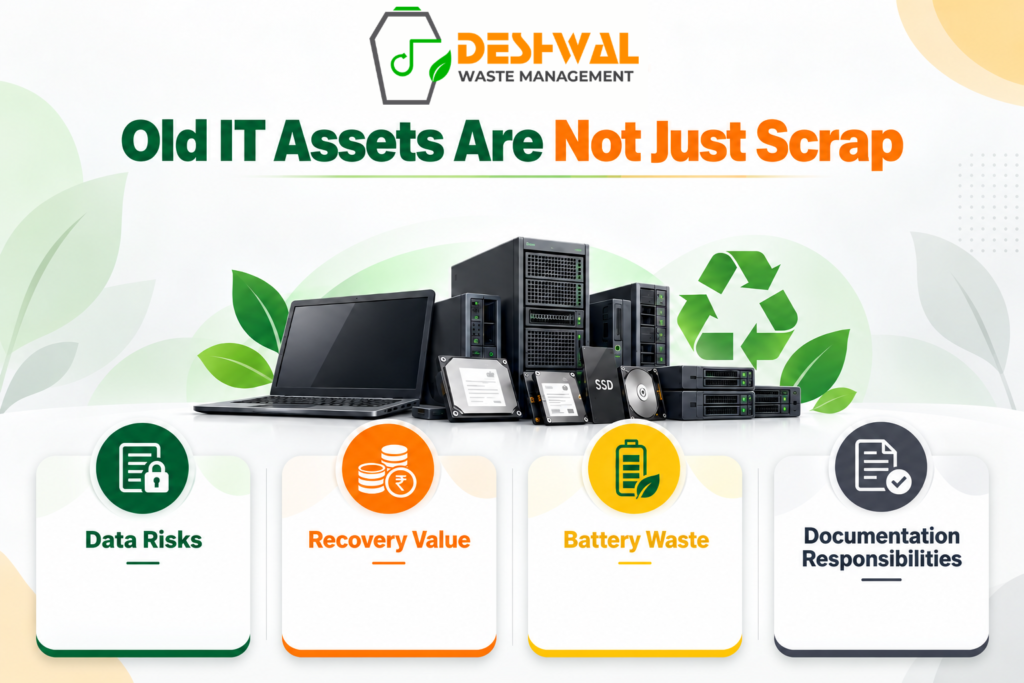
Old laptops, servers, storage devices and other IT equipment are not just unwanted hardware. Every retired asset can carry sensitive data, residual value, reusable components, battery waste, recycling requirements and documentation responsibilities.
This is why responsible technology retirement in India requires a structured IT asset disposition process. Organisations need a process that covers security, traceability, recovery, refurbishment coordination, recycling and closure documentation.
The visit also highlighted a larger business reality. As more Japanese companies, GCCs, OEMs and multinational organisations operate in India, technology retirement cannot be handled as an informal disposal activity. It needs the same discipline that IT teams already apply to procurement, deployment and operations.
Data Security Comes First
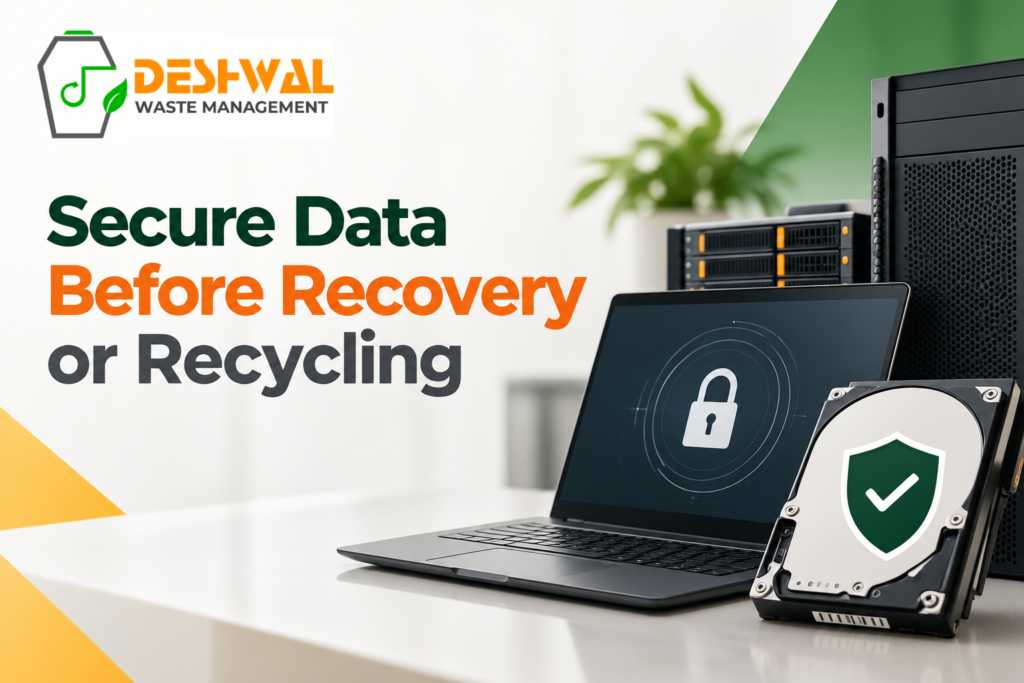
Before an IT asset can be reused, refurbished, or recycled, the data stored on it must be handled securely.
Retired laptops, servers, hard drives, SSDs and some networking equipment may still contain confidential business information. This can include employee records, customer data, financial files, internal documents, credentials, source code or configuration details.
Simply deleting files or formatting a device may not provide enough assurance for enterprise security requirements.
A mature enterprise ITAD process therefore includes secure data sanitisation or physical data destruction as an essential first step. The objective is not only to remove data, but to create a record that shows how data-bearing assets were handled.
For Japanese companies and other multinational organisations operating in India, this is especially important because local asset retirement often needs to align with wider global information-security policies.
This is where a structured IT asset disposal and e-waste recycling process becomes important. It helps IT teams avoid a situation where hardware recovery moves ahead of data-risk closure.
Traceability Across the Asset Journey
Once equipment leaves an office, warehouse or data centre, organisations need visibility over what happens next.
A strong IT asset disposal process should provide a clear chain of custody covering collection, transportation, receipt, processing and final disposition.
Businesses should be able to answer simple but important questions. What assets were collected? Where did they come from? Who handled them after pickup? Were data-bearing assets sanitised or destroyed? How were assets assessed for recovery or recycling? What was the final outcome?
This level of IT asset traceability makes the process easier to review and reduces uncertainty around retired technology.
For organisations operating across multiple locations in India, consistency is equally important. The same controls should apply whether assets are collected from one corporate office, several branches, a warehouse, a manufacturing site or a data centre.
Traceability also matters during office closures, IT refreshes and infrastructure removals. In such cases, companies may need office and IT-infrastructure dismantling support so that IT assets, data-bearing equipment, UPS systems, batteries and recyclable streams are separated from general office clearance.
Reuse Before Recycling
One of the key principles of responsible technology retirement is that every retired asset does not automatically need to become e-waste.
After secure data handling and technical assessment, some devices may still have a useful second life.
Where appropriate, assets can be reused or refurbished before recycling is considered. This extends the usable life of equipment and can also create better opportunities for IT asset recovery.
A responsible process therefore follows a practical hierarchy:
secure data → assess assets → reuse or refurbish → recover value → recycle responsibly
This helps organisations move away from a simple disposal mindset towards a more circular approach.
For example, a laptop that has reached the end of one employee lifecycle may still be suitable for repair, refurbishment, parts recovery or second-life use after data risk has been addressed. A server may no longer fit the original enterprise requirement but may still contain recoverable components. A device that cannot be reused may move into responsible recycling.
This is where recycle and reuse thinking becomes important. The goal is not to recycle everything immediately. The goal is to choose the right route after security, condition, value and documentation have been considered.
Recovering Value Responsibly
Retired IT equipment may still hold financial value, but this depends on factors such as age, condition, configuration, component health and market demand.
A structured IT asset recovery process helps identify which assets can be refurbished, remarketed, reused, harvested for parts or recycled.
However, value recovery should never come at the cost of data security, chain of custody or compliance-related documentation.
The highest recovery quote is not always the strongest outcome if the process does not clearly show how assets were collected, how data was handled, how exceptions were recorded, and how final closure was documented.
Asset recovery should be risk-adjusted. Procurement teams may look at recovery value, but IT, security, finance, ESG and compliance teams also need proof that the process was controlled.
Recycling What Cannot Be Reused
Some equipment eventually reaches the end of its usable life.
At that stage, responsible e-waste recycling becomes essential.
Assets that cannot be refurbished, reused, repaired or recovered should move through formal recycling channels where materials can be handled and recovered responsibly.
This may include laptops, desktops, servers, monitors, printers, cables, networking equipment, storage devices, PCBs, metals, lithium-ion batteries, lead-acid battery waste and plastic fractions recovered from e-waste.
Battery waste also needs careful handling. Technology retirement may involve lithium-ion batteries from laptops and devices, and lead-acid battery waste from UPS systems or backup power units. These streams should be identified and routed separately where relevant.
For companies managing large volumes of electronic waste, e-waste management in India is not just an environmental topic. It is also an operational, data-security and documentation issue.
Documentation Creates Proof
Responsible technology retirement does not end when equipment is collected or processed.
Organisations also need documentation that shows what happened to each asset.
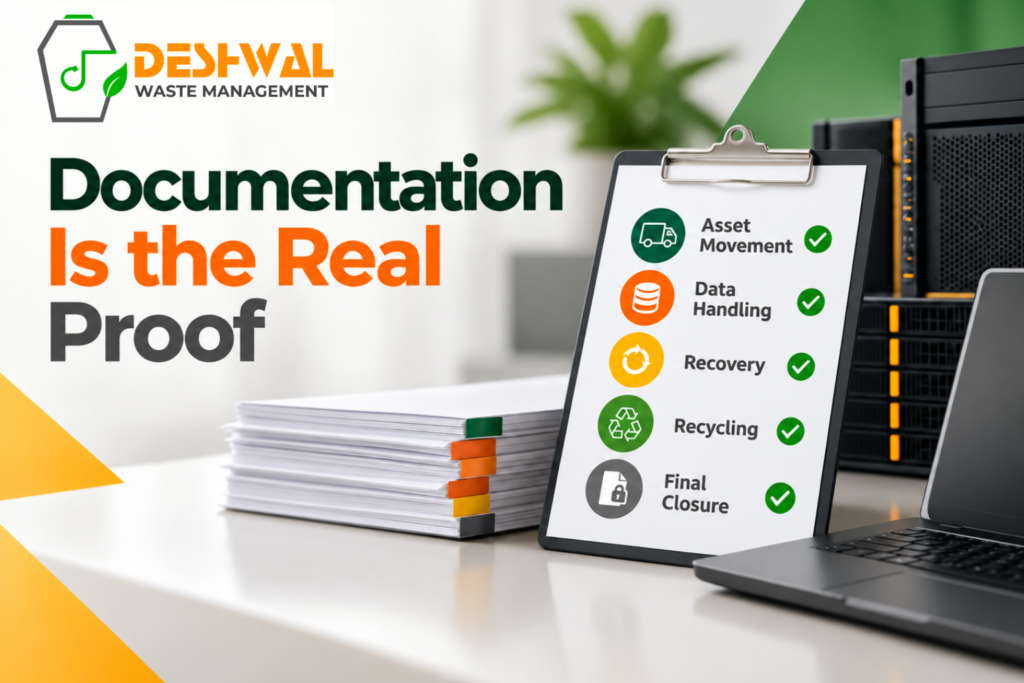
This may include asset inventory records, pickup records, chain-of-custody details, data sanitisation or destruction evidence, refurbishment or recovery records, recycling documentation, battery-waste records, EPR-related documentation where applicable and final closure reports.
For IT, procurement, sustainability and compliance teams, these records provide the proof needed for internal reporting, audits and governance.
A certificate can be useful, but it should not carry the entire burden of proof. Companies may need a broader closure file that connects asset inventory, movement, data handling, recovery route, recycling route and final outcome.
For relevant producer or regulated contexts, records may also support e-waste annual return filing. For relevant listed entities, ITAD and recycling records may also support BRSR-related inputs.
The stronger outcome is not only that assets were removed. The stronger outcome is that the organisation can prove how the asset lifecycle was closed.
A More Structured Approach to Technology Retirement
The Japanese delegation visit to Deshwal showed that retiring technology responsibly is a connected process, not a single recycling activity.
Responsible technology retirement starts when an asset leaves active use and ends when the organisation can clearly prove what happened to it.
That is the real value of a structured ITAD approach: it helps organisations retire technology with security, traceability, recovery value and proof.
To discuss secure ITAD, asset recovery, e-waste recycling and documentation-led closure for your enterprise, contact Deshwal.