Why ITAD matters now
For many Indian enterprises, old IT assets are still treated as a disposal task.
Laptops are listed. Desktops are collected. Servers are removed. Storage drives, monitors, networking equipment, batteries and accessories are bundled into a lot. Vendors are asked for quotes. The highest recovery value or the fastest pickup often becomes the preferred option.
That approach is risky.
Retired IT assets are not ordinary scrap. They may still contain business data, employee information, customer records, credentials, financial documents, source code or sensitive configuration files. They may also contain recoverable materials, usable parts, lithium-ion batteries, lead-acid battery waste, circuit boards and plastic fractions recovered from e-waste.
For IT and procurement teams, the real question is not only:
“Who will take these assets and offer the best recovery value?”
The direct answer is: the highest recovery value is useful only when the asset movement, data handling, recycling route and closure records can also be proven.
The better question is:
“Can we prove how every asset was collected, sanitised, recovered, recycled or closed?”
That is where ITAD becomes important.
What is ITAD?
ITAD means IT Asset Disposition.
It is the controlled process of managing retired, returned, obsolete, damaged or end-of-life IT assets in a secure, documented and responsible way.
In simple terms, ITAD helps enterprises answer five questions.
What asset is being retired?
The asset should be identified by device type, asset tag, serial number, location, user or department, condition and data-bearing status.
A laptop, server, hard drive, SSD, printer, monitor, UPS system or networking device should not be treated as an anonymous item in a mixed scrap lot. It should be clear what the asset is, where it came from and whether it may carry data, recovery value or recycling responsibility.
Where did the asset go?
The movement of the asset should be tracked from collection to receiving, processing and final disposition.
For a single office, this may be straightforward. For a multi-location enterprise, the process may involve branches, plants, warehouses, data centres, IT stores or remote users. Without a clear movement trail, it becomes difficult to answer what happened after pickup.
Was the data removed?
Laptops, desktops, servers, hard drives, SSDs, storage systems and some networking devices may need sanitisation, wiping, destruction or other approved data-removal methods before they move forward.
Deleting files, formatting a system or resetting an operating system does not automatically prove that data risk has been closed. Enterprises need a process that records how data-bearing assets were handled and how exceptions were closed.
What value or route was recovered?
The asset may be bought back, redeployed, repaired, refurbished, remarketed, harvested for parts, recycled or destroyed, depending on condition, data status and enterprise policy.
This is where ITAD protects both value and control. Not every retired asset should immediately become waste. Some assets may still have recovery value once data risk has been addressed.
Can the outcome be proven later?
The process should create records such as pickup details, chain-of-custody documents, sanitisation or destruction evidence, recovery summaries, recycling records and closure reporting.
For Deshwal, ITAD sits on the return side of the enterprise technology lifecycle. Its role includes buyback, ITAD, sanitisation, reverse logistics, data destruction, asset recovery, refurbishment coordination, recycling, EPR support and compliance reporting.
ITAD is not the same as scrap disposal
The biggest mistake enterprises make is treating ITAD like scrap disposal.
Scrap-style disposal focuses mainly on clearing material and recovering some commercial value. ITAD focuses on asset control, data risk, recovery value, recycling responsibility and closure proof.
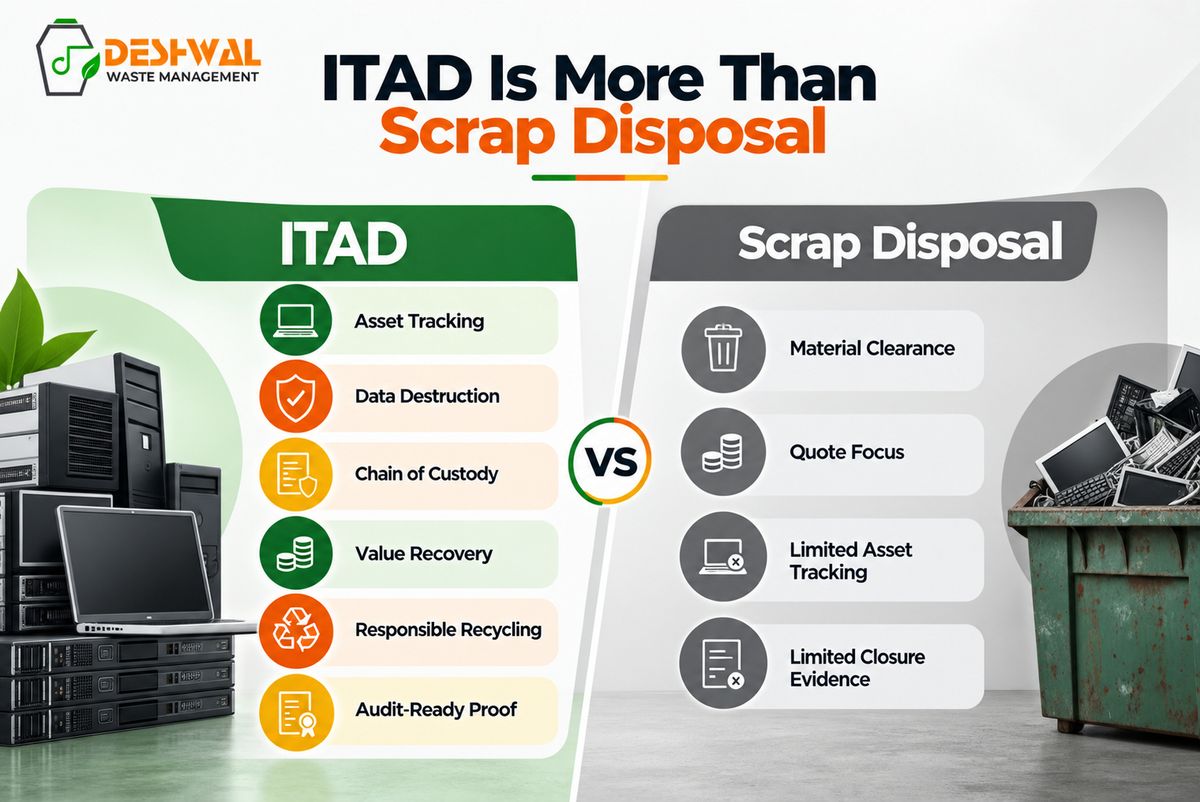
A scrap-style question is:
“Who gives the highest quote?”
The answer may be commercially attractive, but it does not automatically answer the questions that matter to IT, security, procurement, finance, ESG or compliance teams.
An ITAD question is:
“Which assets were collected, who handled them, was data destroyed, what route did each asset follow, what value was recovered and what proof exists?”
This distinction matters for MNCs, GCCs, BFSI firms, IT/ITES companies, manufacturers, telecom operators, healthcare chains, government bodies and multi-location enterprises.
These organisations often need more than a certificate. They need evidence that can be reviewed by IT, security, procurement, finance, ESG, compliance, internal audit or a global parent team.
The core steps in an ITAD process
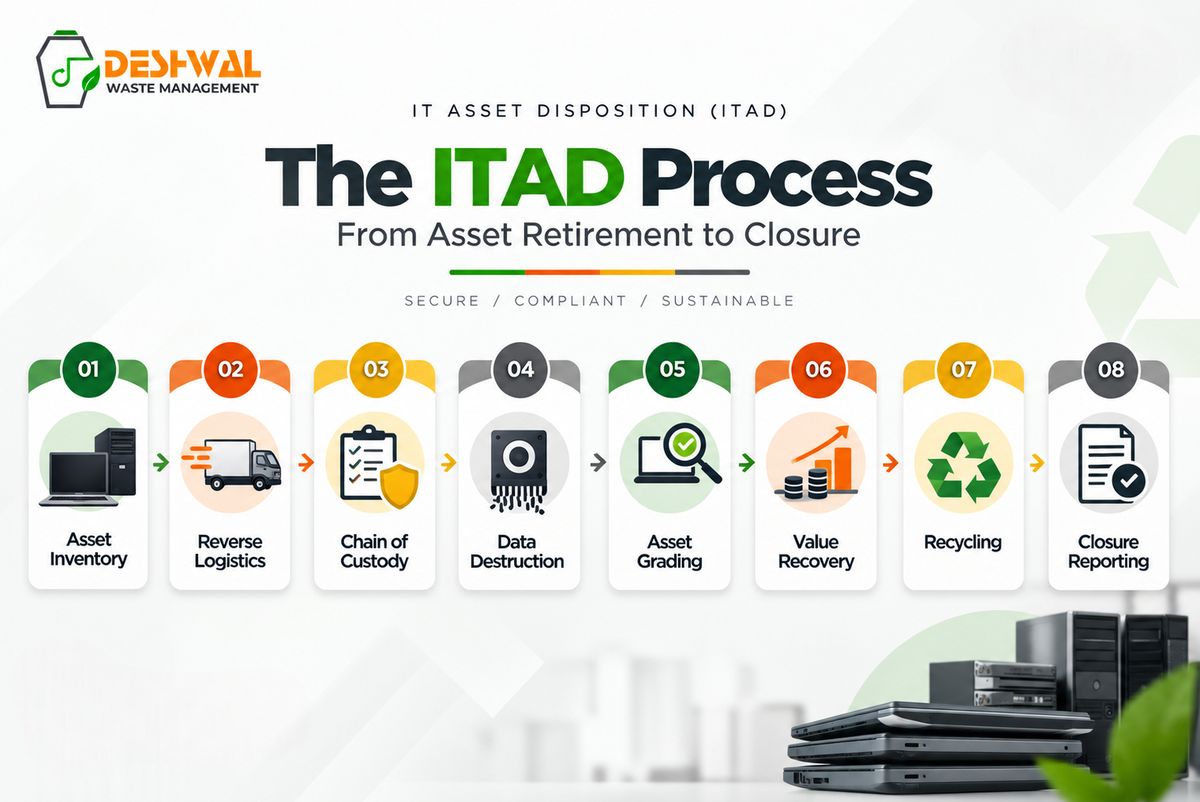
Asset inventory and reconciliation
The ITAD process should begin with a clear asset list.
This includes laptops, desktops, servers, storage drives, monitors, networking devices, batteries, peripherals, cables, accessories and other IT equipment. The inventory should capture asset tags, serial numbers, locations, quantities, condition and whether the asset contains data-bearing media.
Reconciliation is important because the process fails when the asset list is weak. If the enterprise does not know what should be collected, it cannot prove what was collected, processed or closed.
A strong inventory also helps procurement and finance teams connect recovered value back to actual assets instead of relying only on batch-level assumptions.
Reverse logistics and chain of custody
Reverse logistics is the movement of retired assets from enterprise sites back into a controlled processing route.
For a single office, this may be simple. For a multi-location enterprise, it may involve branches, plants, warehouses, data centres, remote users or IT stores.
A pickup receipt is not enough. Enterprises need chain-of-custody records that show collection, transfer, receiving, exceptions and movement into data destruction, recovery, recycling or final disposition.
This helps reduce disputes around missing devices, mismatched serial numbers, missing drives, damaged assets or incomplete returns.
Data sanitisation or physical data destruction
Data destruction is one of the most important parts of ITAD.
Deleting files, formatting a laptop or resetting an operating system does not automatically prove that data is unrecoverable.
Depending on the asset type, media condition, data sensitivity and enterprise policy, data handling may include software-based wiping, purge methods, degaussing, drilling, shredding or physical destruction.
A strong process should record which asset was processed, what method was used, whether the process passed or failed, how exceptions were handled and what evidence was issued.
No data-bearing asset should move into reuse, resale, refurbishment, recycling or disposal without data risk being addressed first.
Grading, recovery and route decision
Not every retired IT asset should go directly to recycling.
Some devices still have usable life. Some may be suitable for repair, refurbishment or second-life use. Some may be remarketed. Some may be harvested for parts. Some should be recycled. Some must be destroyed.
This is where ITAD protects both value and risk.
A mature route decision considers device condition, age, specifications, data status, recovery value, repair viability, compliance requirement and customer policy.
Where repair, refurbishment or second-life activity is part of the project, OXYPC and Renew Circuits should be positioned as supporting repair, refurbishment and second-life channels. The main ITAD, recycling and reporting context should remain with Deshwal.
Office and IT-infrastructure dismantling
In some enterprise projects, ITAD is not limited to loose devices.
Office closures, branch consolidations, IT refreshes, lab shutdowns and data-centre decommissioning projects may require office and IT-infrastructure dismantling.
This can include removal of IT racks, servers, networking equipment, storage systems, UPS units, cables, batteries, monitors, access devices and other infrastructure assets.
The dismantling process should be planned carefully because these assets may carry data, safety, recovery, recycling and reporting implications.
Recycling and material recovery
Assets that cannot be reused, repaired, refurbished or remarketed should move into recycling or material recovery routes.
This may include e-waste recycling, lithium-ion and lead-acid battery waste handling, PCB recovery, metals recovery and plastic fractions recovered from e-waste.
For plastic waste, the wording should stay specific: plastic fractions recovered from e-waste. The article should not claim PET recycling or general plastic-waste processing.
Recycling records should connect back to the original asset inventory wherever required for audit, EPR, ESG or closure reporting.
For battery-related streams, enterprises should also consider documented handling of lithium-ion and lead-acid battery waste through relevant battery recycling routes.
EPR, reporting and closure documentation
For relevant entities and situations, ITAD records may support EPR-related documentation and e-waste annual return filing.
For relevant listed entities, ITAD and recycling records may also support BRSR-related data inputs. BRSR should not be described as applicable to every enterprise.
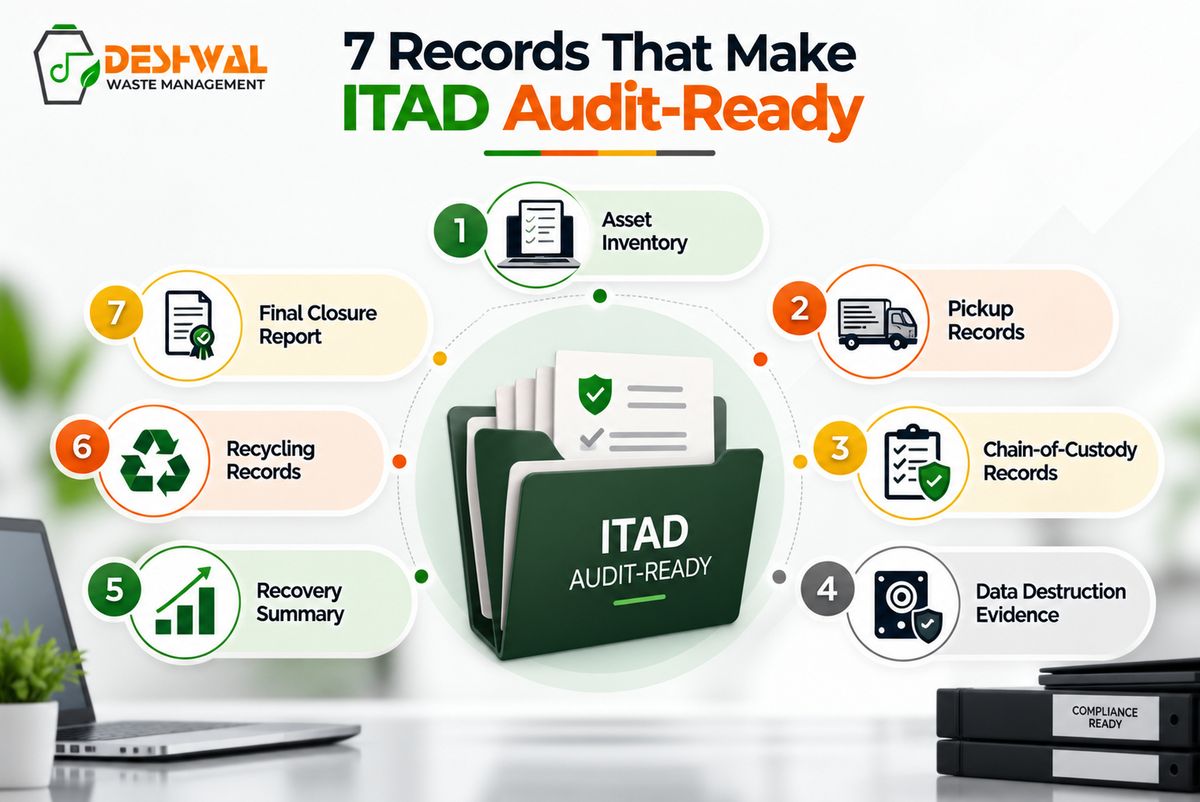
A complete closure file may include asset inventory, pickup records, custody records, data sanitisation or destruction evidence, failed-wipe reports, route decisions, recovery summaries, recycling records, battery-waste records, EPR-support documentation and final closure reporting.
A certificate is useful, but it should not carry the full burden of proof.
The stronger outcome is an audit-ready record.
What IT teams should look for
IT teams should evaluate whether an ITAD process protects asset control and data security.
Can every asset be tracked?
The answer should be yes through asset tags, serial numbers, pickup records, receiving records and closure documentation.
A weak asset list can create problems later because the team may not know whether an asset was collected, missed, damaged, wiped, recovered or recycled.
Are data-bearing assets identified?
The answer should be yes before assets move into reuse, recycling or disposal.
IT teams should know which assets may contain storage media, configuration data or sensitive information. These assets should move through sanitisation or destruction controls before any route decision is finalised.
Are failed wipes and exceptions documented?
The answer should be yes. Failed wipes, missing drives, mismatched serial numbers and damaged assets should not disappear from the record.
Exception reporting is important because real projects rarely move perfectly. The process should show how issues were identified, escalated and closed.
Is closure evidence easy to retrieve?
The answer should be yes through organised records that can be reviewed after the disposal project is complete.
For IT teams, closure evidence reduces uncertainty. It shows that retired assets did not simply leave the premises; they moved through a documented retirement process.
What procurement teams should look for
Procurement teams should evaluate more than the highest recovery quote.
What is included in the recovery quote?
The answer should clarify whether collection, reverse logistics, data sanitisation, dismantling, recycling, reporting and closure documentation are included or priced separately.
A high recovery quote may look attractive, but it should be compared against the full scope of work.
Is the recovery value risk-adjusted?
The answer should consider whether the quote protects data security, chain of custody and reporting evidence.
The strongest commercial outcome is not only the highest number. It is a recovery outcome that does not weaken data protection, recycling discipline or documentation.
Who owns exceptions?
The answer should be clear before the project starts. Missing assets, failed data destruction, damaged devices and mismatched serial numbers need defined handling.
Without exception ownership, small gaps can become unresolved disputes between the enterprise and the vendor.
Are services contracted clearly?
The answer should reflect the actual contracting and invoicing model. If multiple capabilities are coordinated, ownership should be clearly identified.
This is especially important when asset recovery, refurbishment coordination, recycling, data destruction, dismantling or EPR-related support are part of the same project.
Why Deshwal is relevant for enterprise ITAD
Deshwal’s ITAD role is strongest where enterprises need control over the return side of the asset lifecycle.
This includes buyback, ITAD, sanitisation, reverse logistics, data destruction, asset recovery, refurbishment coordination, e-waste recycling and disposal services, lithium-ion and lead-acid battery waste handling, EPR support and compliance reporting.
For Indian enterprises, this matters because ITAD is not a one-department task.
IT needs visibility.
Security needs data proof.
Procurement needs accountable execution.
Finance needs recovery-value reconciliation.
ESG and compliance teams need records that can support review, EPR-related documentation, BRSR inputs for relevant listed entities and closure reporting.
The goal is not simply to remove old hardware.
The goal is to close the asset record with evidence.
FAQs
What is ITAD?
ITAD stands for IT Asset Disposition. It is the structured process of retiring IT assets through collection, tracking, data sanitisation or destruction, recovery, reuse, refurbishment coordination, recycling and closure reporting.
Why is ITAD important for Indian enterprises?
ITAD is important because retired IT assets may contain sensitive data, recoverable value, recyclable materials and documentation requirements. Without a controlled ITAD process, enterprises may face data-risk gaps, missing asset records, unclear recovery value and weak closure evidence.
Is ITAD the same as e-waste recycling?
No. E-waste recycling is one possible route within ITAD. ITAD is broader. It includes inventory, reverse logistics, chain of custody, data destruction, recovery, refurbishment coordination, recycling and reporting.
What is the difference between ITAD and scrap disposal?
Scrap disposal mainly focuses on clearing material and recovering value. ITAD focuses on asset control, data destruction, route decisions, recycling responsibility, compliance reporting and audit-ready closure.
Should procurement choose the highest recovery quote?
Not automatically. A higher recovery quote is useful only if it does not weaken custody, data destruction, recycling evidence or closure reporting. Procurement should evaluate recovery value along with risk control and documentation.
What documents should an ITAD process include?
An ITAD process may include asset inventory, pickup records, chain-of-custody documents, data sanitisation or destruction evidence, failed-wipe reports, route decisions, recovery summaries, recycling records and final closure reports.
Can old IT assets be reused before recycling?
Yes. Some retired assets can be repaired, refurbished, redeployed, remarketed or harvested for parts if data risk has been addressed and the route is documented. Recycling should be used for assets that cannot be safely or commercially extended.