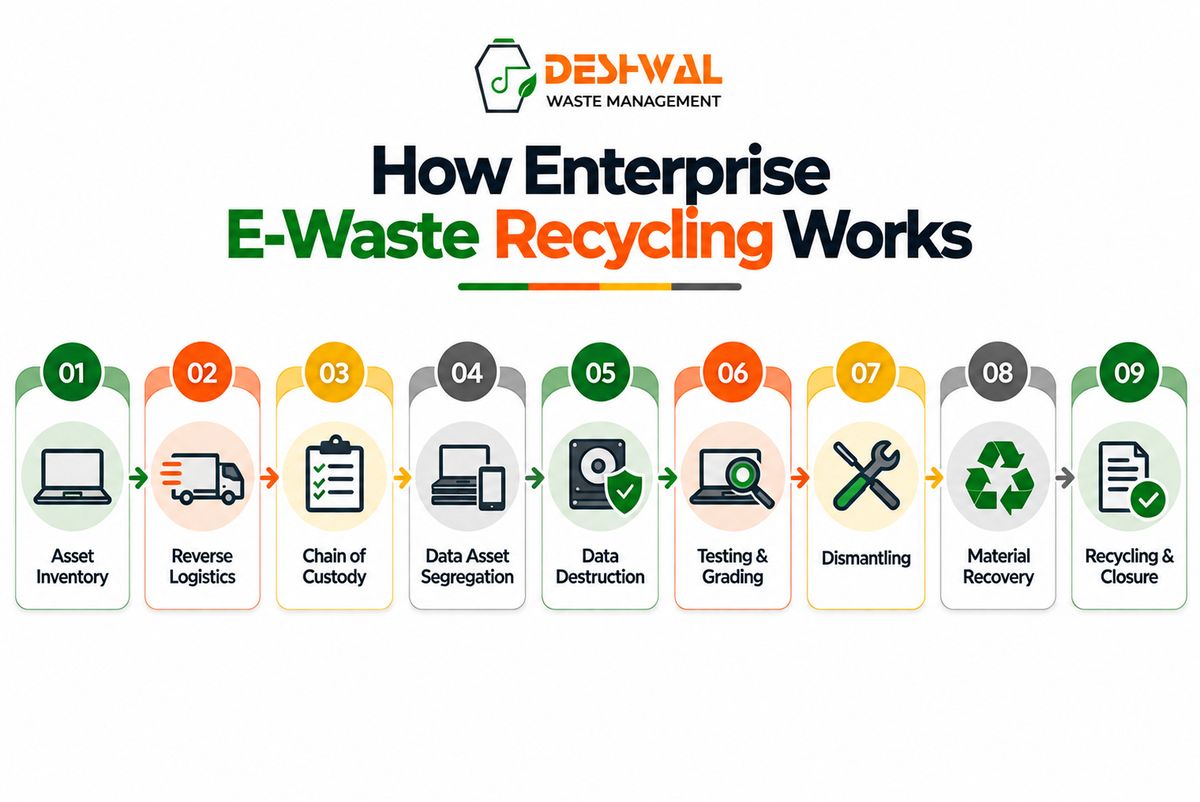
The e-waste recycling process starts with asset identification and collection, then moves through chain of custody, data sanitisation or destruction, grading, dismantling, material separation, recycling and closure reporting. For Indian enterprises, the process should create proof that IT assets were handled securely, recovered responsibly and documented for audit, EPR, ESG or internal review needs.
Why enterprises need a structured e-waste recycling process
For many organisations, e-waste recycling begins when old electronics are ready to leave the office.
Laptops are collected. Desktops are packed. Servers are removed. Monitors, printers, storage drives, networking devices, batteries, cables and accessories are listed. A vendor arrives, picks up the material and later shares a certificate.
That may look complete, but for an enterprise, pickup is only the beginning.
E-waste recycling is not just about removing old electronics. It is about controlling what happens to data-bearing assets, recoverable materials, battery waste, circuit boards, plastic fractions recovered from e-waste and compliance-sensitive records after the assets leave the organisation.
For MNCs, GCCs, BFSI firms, IT/ITES companies, manufacturers, healthcare chains, telecom operators, government bodies and multi-location enterprises, the recycling process should answer clear questions.
What was collected?
The process should begin with an inventory that identifies devices, categories, serial numbers, asset tags and locations.
Was data destroyed or made unrecoverable?
Data-bearing assets should not move into reuse, refurbishment, recycling or disposal without sanitisation or destruction controls.
What route did each asset follow?
Some assets may be recovered, repaired, refurbished, reused or harvested for parts. Others may move into recycling or destruction.
Can the outcome be proven later?
The enterprise should be able to retrieve collection records, custody evidence, sanitisation proof, recycling documentation and closure reports.
This is the difference between basic e-waste pickup and enterprise-grade recycling discipline.
Asset identification and inventory
The e-waste recycling process should begin before pickup.
The enterprise must first identify what is being retired. This may include laptops, desktops, servers, monitors, printers, scanners, storage drives, SSDs, hard drives, mobile devices, networking equipment, UPS systems, lithium-ion batteries, lead-acid battery waste, cables, adapters, accessories and other IT infrastructure assets.
A useful inventory should capture asset category, serial number, asset tag, location, user or department, condition, quantity, data-bearing status and any missing components or accessories.
This step matters because recycling cannot be documented properly if the asset list is weak.
If an enterprise does not know what should be collected, it cannot prove what was collected. If it cannot prove what was collected, it cannot prove what was sanitised, recovered, recycled or closed.
For Deshwal-led projects, asset identification helps create the base record for reverse logistics, data destruction, asset recovery, recycling and closure reporting.
Reverse logistics and collection planning
Reverse logistics is the movement of retired assets from enterprise locations back into a controlled processing route.
For a single office, collection may be straightforward. For a multi-location enterprise, it may involve branches, plants, warehouses, IT stores, data centres, remote employees or regional offices.
Collection planning should define pickup locations, asset quantities, packaging needs, site contacts, collection dates, documentation requirements and exception handling for missing or mismatched assets.
This matters because e-waste is not ordinary office waste.
A retired laptop may still contain data. A server may still contain storage media. A UPS system may include battery waste. A network device may contain configuration data. A branded asset may create reputation risk if it enters informal channels.
A controlled collection process ensures assets enter the recycling or ITAD workflow with proper records from the beginning.
Where office closures, lab shutdowns, branch exits or IT refreshes are involved, the scope may also include office and IT-infrastructure dismantling. That can include racks, cables, access devices, networking equipment, storage systems, UPS units, batteries and related infrastructure.
Chain of custody and receiving
A pickup receipt is not chain of custody.
A pickup receipt may confirm that assets were collected, but it does not show the full movement trail. Chain of custody documents who handled the assets, where they moved, when they were received and what happened next.
A mature custody trail may include pickup acknowledgement, asset or batch details, serial-number references where applicable, transfer records, receiving confirmation, mismatch notes, damaged-asset notes and movement into data destruction, grading, recovery, recycling or final disposition.
Receiving and reconciliation are important parts of this stage.
When assets arrive at the receiving point, the received material should be checked against the collection record. The team should identify missing assets, extra assets, damaged devices, missing drives, mismatched serial numbers, missing chargers or category differences.
This matters because exceptions often become audit questions later.
A mature process does not hide exceptions. It records them, routes them and closes them.
Data-bearing asset segregation
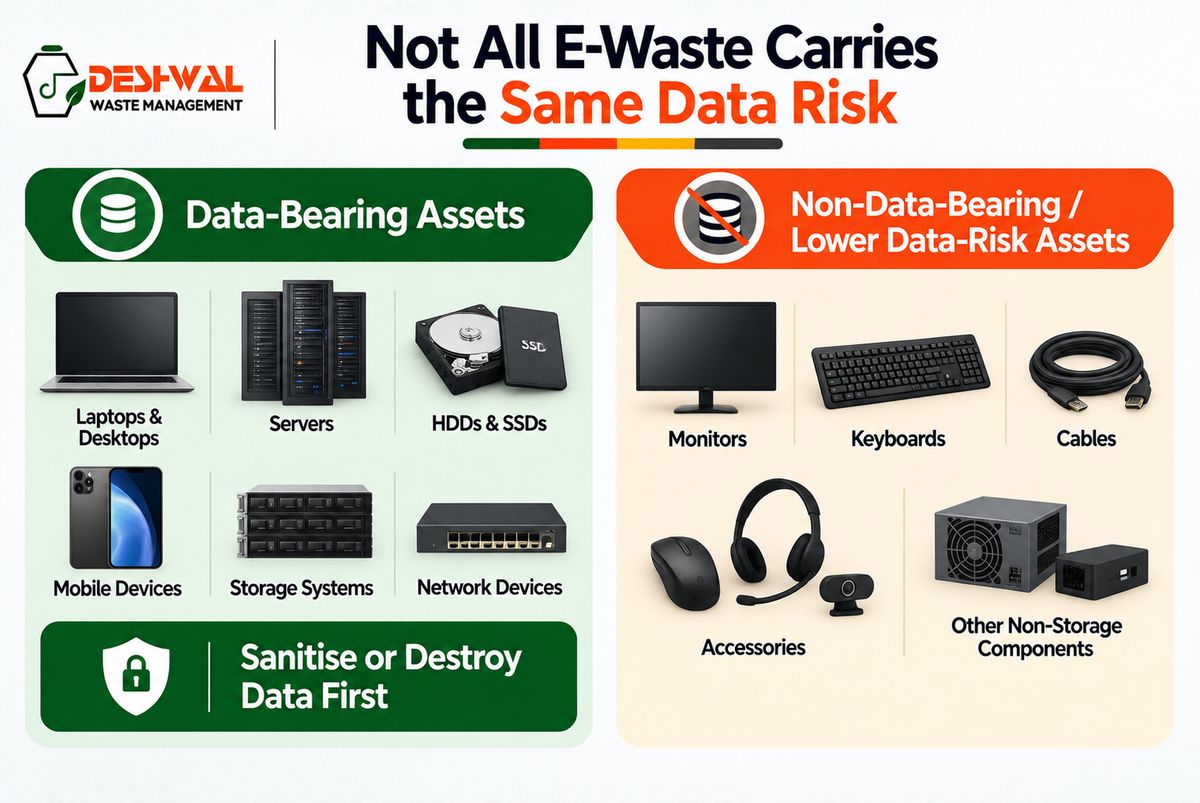
Not all e-waste carries the same risk.
A keyboard and a hard drive do not need the same level of control. A broken monitor and a server do not carry the same data exposure. A printer, laptop, desktop, SSD, backup device or network appliance may store information or configuration data.
That is why data-bearing assets should be identified and segregated before further processing.
This may include laptops, desktops, servers, hard drives, SSDs, storage arrays, backup devices, mobile devices, printers with storage components and networking equipment with memory or configuration data.
This is the stage where e-waste recycling overlaps with ITAD.
For enterprises, recycling should not begin by breaking down devices blindly. It should begin by identifying which assets carry data risk and routing them through sanitisation or physical destruction controls.
Data sanitisation or physical data destruction
Data sanitisation is one of the most important stages in enterprise e-waste recycling.
Deleting files is not enough. Formatting a device is not enough. Resetting an operating system is not enough.
For data-bearing assets, the enterprise needs evidence that the data was wiped, destroyed or rendered unrecoverable before the asset is reused, refurbished, recycled or disposed of.
Depending on the asset type, media condition, sensitivity and enterprise policy, data handling may include software-based wiping, purge methods, degaussing, drilling, shredding or physical destruction.
A useful data-destruction record should show which asset was processed, what method was used, whether the process passed or failed, how failed or non-wipeable media was handled and what evidence was issued.
For Deshwal content, the key point is simple: hardware recovery should never move ahead of data-risk closure.
Testing, grading and asset recovery decision
After data risk is addressed, assets should be assessed for their next route.
Not every retired asset should go directly into recycling.
Some devices may still have useful life. Some may be suitable for repair. Some may be refurbished. Some may be remarketed. Some may be harvested for parts. Some may have no reuse value and should move into recycling or destruction.
This step is often called grading or triage.
The route decision may consider working condition, age, specifications, cosmetic condition, component health, battery condition, resale potential, repair viability, data status and enterprise policy.
This is where asset recovery becomes important.
If a device can be safely repaired, refurbished or moved into a second-life route after data risk has been addressed, recycling may not be the best first route. Reuse and recovery can protect value and support circularity.
Where repair, refurbishment or second-life activity is part of the project, OXYPC and Renew Circuits should be positioned as supporting repair, refurbishment and second-life channels. The main e-waste recycling, ITAD and reporting context should remain with Deshwal.
The decision should be based on evidence, not guesswork.
Dismantling and material separation
Assets that cannot be reused, repaired, refurbished or remarketed move into dismantling and material separation.
This is where physical processing begins.
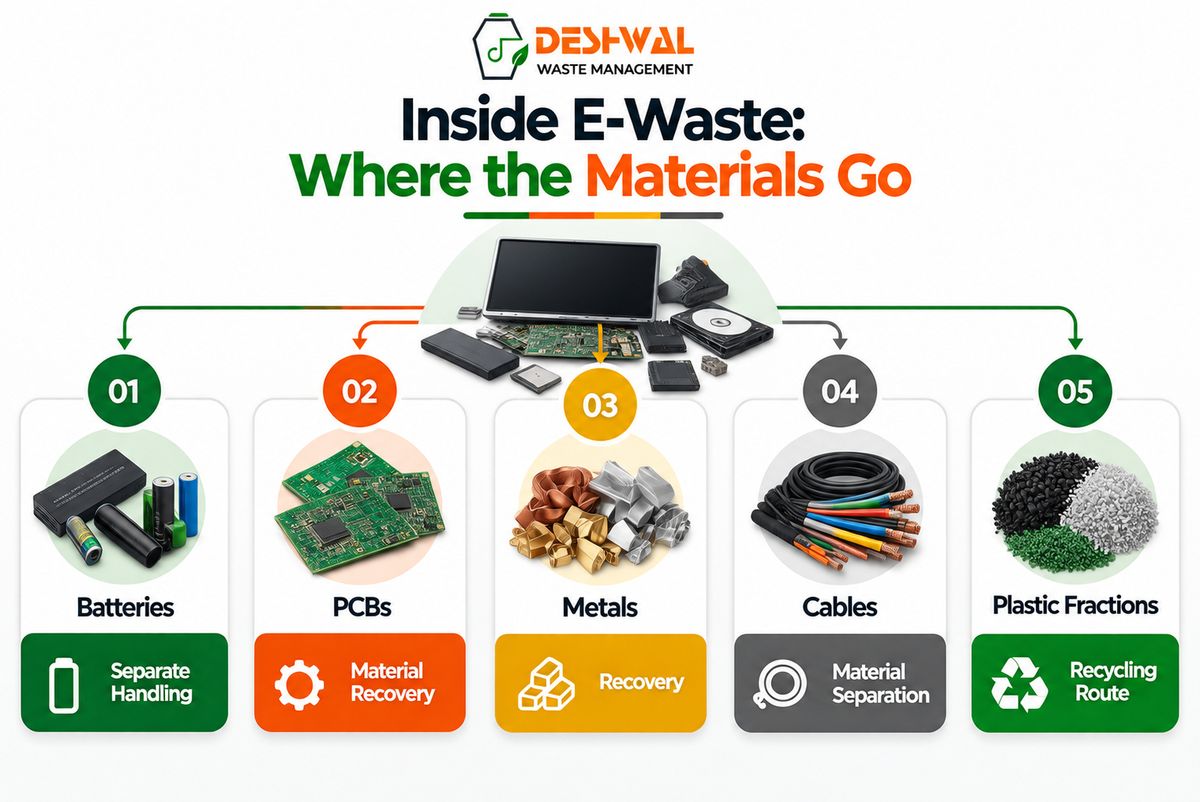
Devices may be separated into material streams such as metals, plastic fractions recovered from e-waste, PCBs, lithium-ion batteries, lead-acid battery waste, cables, glass, screens, casings, storage media, components and reusable spare parts.
Dismantling should not be described as casual breaking.
It should be treated as controlled separation of components and materials so that each stream can move into the appropriate recovery, recycling or disposal route.
For enterprise e-waste, this stage also has documentation value. The organisation may need to show that assets were not routed informally and that material streams were processed through documented channels.
Battery, PCB, metal and plastic-fraction recovery
E-waste contains multiple material streams, and each one requires appropriate handling.
Lithium-ion and lead-acid battery waste should be identified and routed carefully because battery waste carries safety, handling and regulatory considerations.
PCBs may contain recoverable materials and should not be handled casually.
Metals may move into material recovery routes, including precious metal recovery from electronics where relevant.
Plastics should be described only as plastic fractions recovered from e-waste.
A mature recycling process should document how these material streams are handled. The records may include battery-waste documentation, PCB recovery records, material recovery summaries, recycling evidence, exception records and closure reports.
For battery-related streams, enterprises should also consider documented handling of lithium-ion and lead-acid battery waste through relevant battery recycling routes.
For enterprises, this matters because ESG and compliance teams increasingly need traceable data, not broad recycling claims.
Recycling, reporting and final closure
The final stage of the e-waste recycling process is not only physical recycling.
It is closure reporting.
Closure means the enterprise can prove what happened to the material and assets after collection.
A strong closure file may include asset inventory, pickup records, custody records, receiving and reconciliation reports, data sanitisation or destruction evidence, failed-wipe notes, grading decisions, asset recovery summaries, recycling records, battery-waste records, material recovery documentation, EPR-support records where applicable and final closure reporting.
For relevant listed entities, recycling and ITAD records may also support BRSR-related inputs. BRSR should not be presented as applicable to every enterprise.
For relevant producer or regulated contexts, Deshwal may support EPR-related documentation and e-waste annual return filing.
A certificate is useful, but it should not carry the full burden of proof.
Enterprise e-waste recycling should end with a record that can be retrieved, reviewed and defended.
Where Deshwal fits in the e-waste recycling process
Deshwal’s role in enterprise e-waste recycling is strongest on the return side of the asset lifecycle.
This includes reverse logistics, ITAD, data sanitisation, data destruction, buyback, asset recovery, refurbishment coordination, e-waste recycling and disposal services, lithium-ion and lead-acid battery waste handling, plastic fractions recovered from e-waste, EPR support and compliance reporting.
This matters because enterprise recycling is cross-functional.
IT needs asset closure.
Security needs data proof.
Procurement needs accountable execution.
Finance needs recovery-value reconciliation.
ESG and compliance teams need records that can support internal review, EPR-related documentation, BRSR inputs for relevant listed entities and closure reporting.
A basic recycler removes e-waste.
A stronger enterprise recycling process removes uncertainty.
FAQs
What is the e-waste recycling process?
The e-waste recycling process includes asset identification, reverse logistics, collection, chain of custody, receiving, reconciliation, data-bearing asset segregation, data sanitisation or destruction, grading, dismantling, material separation, recycling and closure reporting.
Why is data destruction part of e-waste recycling?
Data destruction is important because many electronic assets contain recoverable information. Laptops, desktops, servers, hard drives, SSDs, printers and networking devices may store data. Enterprises should address data risk before reuse, refurbishment, recycling or disposal.
Is pickup proof enough for enterprise e-waste recycling?
No. Pickup proof only confirms collection. Enterprises also need custody records, receiving confirmation, reconciliation notes, data-destruction evidence, route decisions, recycling records and closure documentation.
Can e-waste be reused before recycling?
Yes. Some retired assets can be repaired, refurbished, redeployed, remarketed or harvested for parts if data risk has been addressed and the route is documented. Recycling should be used for assets that cannot be safely or commercially extended.
What documents should enterprises receive after e-waste recycling?
Enterprises may need asset inventory, pickup records, chain-of-custody documents, data sanitisation or destruction evidence, failed-wipe reports, recovery summaries, recycling records, battery-waste records, EPR-support records where applicable and final closure reports.
Does e-waste recycling support EPR or BRSR reporting?
It can support EPR-related documentation where applicable. For relevant listed entities, recycling and ITAD records may also support BRSR-related inputs. These should be based on documented records, not estimates.
What battery waste should be considered in enterprise e-waste recycling?
Enterprise e-waste recycling may involve lithium-ion and lead-acid battery waste, especially from laptops, UPS systems, backup power units and other equipment. These streams should be identified, handled and documented separately where relevant.