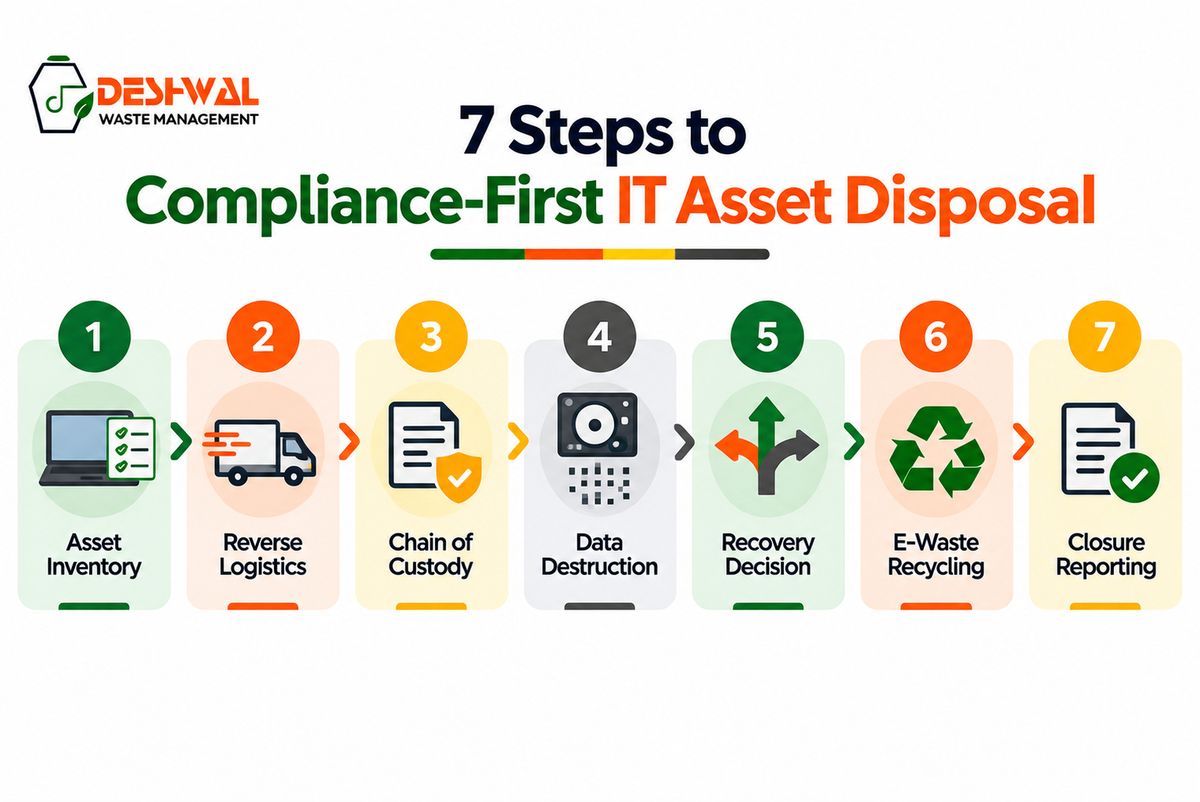
IT asset disposal in India should not be judged only by the highest scrap value or recovery quote. For enterprises, ITAD compliance means controlling asset inventory, reverse logistics, data sanitisation, chain of custody, asset recovery, e-waste recycling, EPR-related documentation and closure reporting before deciding which vendor offers the best commercial return.
Why scrap value should not be the first question
For many enterprises, IT asset disposal starts with one question:
“Who will give us the highest scrap value?”
The honest answer is: the highest-paying vendor is not always the safest or most defensible choice.
At first, choosing the highest quote sounds practical. A refresh cycle is complete. Old laptops, desktops, servers, monitors, storage devices, networking equipment, UPS systems, batteries and accessories need to be cleared. Procurement compares vendor quotes. The highest recovery value appears to be the best outcome.
But retired IT assets are not ordinary scrap.
They may still contain business data, employee records, customer information, credentials, financial files, source code or confidential configuration details. They may also include lithium-ion batteries, lead-acid battery waste, PCBs, metals and plastic fractions recovered from e-waste that need responsible handling and documentation.
A high quote can look good on paper. But it may not answer the questions that matter after the assets leave the premises.
Were all assets listed correctly?
Were devices collected through a controlled reverse-logistics process?
Was chain of custody maintained after pickup?
Were data-bearing assets sanitised or physically destroyed before resale, reuse, recycling or disposal?
Were missing drives, failed wipes, mismatched serial numbers or damaged devices documented?
Was the asset recovery route recorded?
Were recycling records and closure reports maintained?
A higher recovery value is useful only when it is supported by data-risk control, custody evidence, responsible recycling and documentation that can be reviewed later.
For Indian enterprises, the better question is not:
“Who pays the most for old IT assets?”
The better question is:
“Can we prove how every asset was collected, sanitised, recovered, recycled or closed?”
That shift changes IT asset disposal from a scrap sale into a documented ITAD process.
What compliance-first IT asset disposal means
Compliance-first IT asset disposal does not mean ignoring recovery value.
It means recovery value should be evaluated after the enterprise understands the data, custody, recycling and documentation risks connected with the asset lot.
A compliance-first approach begins with asset visibility. The organisation should know which assets are being retired, where they are located, whether they contain data, whether they may carry recovery value and what documentation will be needed after closure.
This may include laptops, desktops, servers, hard drives, SSDs, storage systems, printers, monitors, networking equipment, UPS systems, lithium-ion batteries, lead-acid battery waste, cables, accessories and other IT infrastructure assets.
Compliance-first disposal also means assets should not move through unclear handoffs. A pickup receipt alone is not enough. Enterprises need records that show how assets were collected, transferred, received, processed, recovered, recycled or closed.
Data-bearing assets require special attention. A retired laptop, server, storage drive, backup device or network appliance may still carry sensitive information. These assets should not move into resale, reuse, refurbishment, recycling or disposal until data risk has been addressed.
The same principle applies to recycling and material recovery. E-waste streams should be identified and routed properly, especially when they include batteries, PCBs, metals, cables, storage media and plastic fractions recovered from e-waste.
In simple terms, compliance-first IT asset disposal means the enterprise does not ask for value alone.
It asks for value with proof.
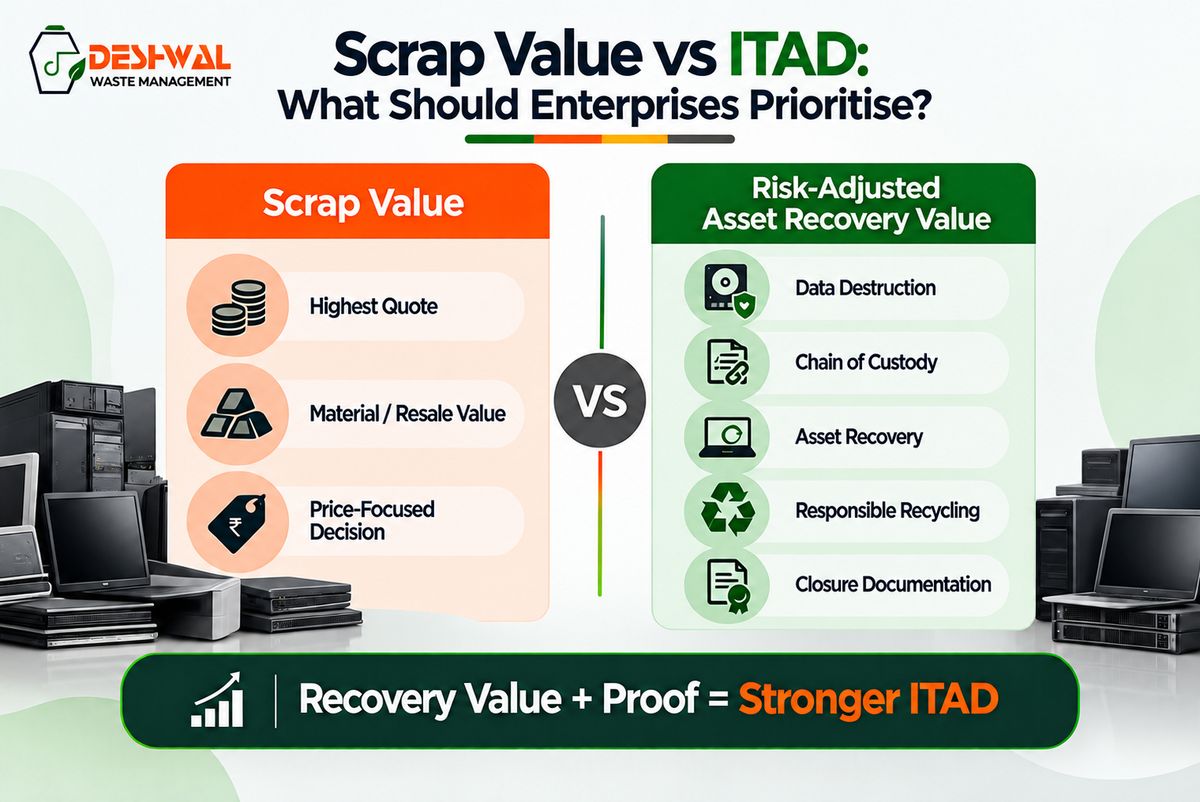
Scrap value vs risk-adjusted asset recovery value
Scrap value is the amount an enterprise may receive for retired equipment as material or resale value.
Risk-adjusted asset recovery value is different.
It considers the commercial return only after accounting for data destruction, chain of custody, reverse logistics, recycling route, documentation and exception handling.
That difference matters.
A vendor may offer a higher price for old laptops, servers or networking equipment. But if the process does not clearly show how devices were collected, whether storage media was handled, how assets were graded, where recoverable items went, how battery waste was routed or what documentation was created, the higher quote may not be the stronger outcome.
A lower quote with better documentation, clearer custody records and stronger closure reporting may be safer for the enterprise.
This does not mean procurement should ignore value. It means procurement should compare value properly.
A useful evaluation should ask:
What is included in the quote?
The answer should clarify whether pickup, packaging, reverse logistics, dismantling, data sanitisation, physical destruction, recycling, reporting and closure documentation are included or charged separately.
What happens to data-bearing assets?
The answer should explain when data risk is addressed and what records are created.
How are assets graded?
The answer should show how devices are routed into buyback, reuse, refurbishment coordination, parts recovery, recycling or destruction.
How are exceptions handled?
The answer should cover missing devices, mismatched serial numbers, damaged assets, failed wipes and missing drives.
What proof will exist later?
The answer should include inventory, custody records, recovery summaries, recycling records and closure reporting.
This is the real comparison: not scrap value versus compliance, but scrap value without proof versus recovery value supported by a controlled ITAD process.
Build a reliable asset inventory
IT asset disposal should begin before pickup.
The first step is to build a reliable asset inventory. This inventory should capture what is being retired, where it is located, who owns or used it, what condition it is in and whether it may contain data.
A typical enterprise IT disposal lot may include laptops, desktops, servers, hard drives, SSDs, storage arrays, monitors, printers, scanners, mobile devices, networking equipment, UPS systems, lithium-ion batteries, lead-acid battery waste, cables, adapters and accessories.
The inventory should include asset category, asset tag, serial number, location, user or department, quantity, condition and data-bearing status.
This matters because a weak inventory creates weak closure.
If the enterprise does not know what should be collected, it cannot prove what was collected. If it cannot prove what was collected, it cannot prove what was sanitised, recovered, recycled or closed.
A reliable inventory also helps finance and procurement teams reconcile asset recovery value with actual equipment. Without asset-level or category-level clarity, the recovery value may remain only a batch-level number.
For enterprises with multiple offices, data centres, warehouses or remote users, inventory quality becomes even more important. The larger the asset base, the easier it is for missing devices, mismatched serial numbers or incomplete returns to create disputes later.
A strong ITAD process starts with a simple principle:
Know the asset before you price the asset.
Plan reverse logistics and collection control
Reverse logistics is the movement of retired assets from enterprise locations back into a controlled processing route.
For a single office, this may be straightforward. For a multi-location enterprise, it may involve branches, plants, warehouses, IT stores, data centres, remote employees, regional offices or project sites.
Collection planning should define pickup locations, site contacts, asset quantities, packaging needs, access requirements, collection dates, documentation requirements and exception handling.
This matters because IT asset disposal is not just transport.
A retired laptop may still contain data. A server may still contain storage media. A UPS system may include battery waste. A network device may contain configuration data. A branded asset may create reputation risk if it enters unclear channels.
Where office closures, branch exits, lab shutdowns, IT refreshes or infrastructure removals are involved, enterprises may also need office and IT-infrastructure dismantling. This can include removal of racks, cables, access devices, servers, storage systems, networking equipment, UPS units, batteries and related infrastructure.
Collection control helps ensure that assets do not disappear between the enterprise site and the processing route.
It also helps reduce confusion around mixed loads, partial pickups, missing drives, damaged devices or assets that were listed but not actually collected.
A well-planned reverse-logistics process protects both compliance and recovery value because it keeps the asset trail intact from the beginning.
Maintain chain of custody after pickup
A pickup receipt is useful, but it is not the same as chain of custody.
A pickup receipt may show that a vendor collected a lot. Chain of custody should show who handled the assets, where they moved, when they were received and what happened next.
This distinction matters because many disposal issues appear after pickup.
An asset may be listed but not received. A server may arrive without a drive. A serial number may not match. A device may be damaged in transit. A batch may include additional items not present in the original record.
A mature chain-of-custody trail may include pickup acknowledgement, asset or batch details, serial-number references where applicable, transfer records, receiving confirmation, mismatch notes, damaged-asset notes, missing-media notes and movement into data destruction, grading, recovery, recycling or final disposition.
This helps different teams answer different questions.
IT can ask whether the asset was received.
Security can ask whether data-bearing media was identified.
Procurement can ask whether the recovery quote still matches the received material.
Finance can ask whether the recovery summary matches the asset record.
ESG and compliance teams can ask whether the final route was documented.
Chain of custody does not remove every risk, but it makes the process visible. That visibility is what separates documented ITAD from basic scrap movement.
Close data risk before recovery or resale
Data risk should be closed before recovery value is finalised.
This is one of the most important principles in IT asset disposal.
A device may look ready for resale, reuse or refurbishment, but if it contains data, the commercial route should wait. Laptops, desktops, servers, hard drives, SSDs, storage systems, backup devices, mobile devices, printers with storage components and some networking equipment may contain information that should be handled first.
Deleting files is not enough. Formatting a system is not enough. Resetting an operating system is not enough.
Depending on the asset type, media condition, sensitivity and enterprise policy, data handling may include software-based wiping, purge methods, degaussing, drilling, shredding or physical destruction.
A useful data-destruction record should show which asset was processed, what method was used, whether the process passed or failed, how failed or non-wipeable media was handled and what evidence was issued.
This step also affects asset recovery value.
A device that passes sanitisation may be suitable for resale, reuse, refurbishment coordination or parts recovery. A device that cannot be wiped may need physical destruction or a different route. A missing drive may need exception reporting before closure.
For secure ITAD, data handling is not a back-office detail.
It is the gate before value recovery.
Decide the right buyback, reuse or recycling route
Once data risk is addressed, each asset should be assessed for its next route.
Not every retired IT asset should go directly into scrap or recycling.
Some devices may still have useful life. Some may be suitable for buyback. Some may be repaired, refurbished, redeployed, remarketed or harvested for parts. Some may have no safe or commercial reuse route and should move into recycling or destruction.
This route decision is where asset recovery value becomes more mature.
A simple scrap process may price the lot mainly by weight or broad category. A stronger ITAD process evaluates device condition, specifications, age, cosmetic quality, component health, battery condition, resale potential, repair viability, data status and enterprise policy.
That approach helps enterprises avoid two common mistakes.
The first mistake is losing value by sending recoverable assets directly into scrap.
The second mistake is chasing value without first controlling data, custody and recycling responsibility.
Where repair, refurbishment or second-life activity is part of the project, OXYPC and Renew Circuits should be positioned as supporting repair, refurbishment and second-life channels. The main ITAD, recycling and reporting context should remain with Deshwal.
For procurement and finance teams, this is important because asset recovery value should be transparent. The enterprise should be able to understand what was bought back, what was reused, what was repaired, what was recycled and what was destroyed.
A good route decision does not only increase value.
It explains value.
Handle batteries, PCBs, metals and plastic fractions correctly
IT asset disposal often includes more than devices.
A retired asset lot may contain lithium-ion batteries from laptops and devices, lead-acid battery waste from UPS systems, PCBs, cables, screens, storage media, metals and plastic fractions recovered from e-waste.
Each material stream should be identified and routed carefully.
Battery waste needs particular attention because lithium-ion and lead-acid battery waste have different handling considerations. Enterprises should avoid treating batteries as ordinary mixed scrap.
For battery-related streams, organisations should consider documented battery recycling routes where relevant.
PCBs and electronics metals may move into material recovery processes. In some cases, precious metal recovery from electronics may be relevant within the wider e-waste recovery chain.
For plastic waste, the wording should remain specific: plastic fractions recovered from e-waste. The article should not claim PET recycling or general plastic-waste processing.
Material handling is important because the asset may be retired, but the enterprise may still need clarity on how streams were recovered, recycled or documented.
A strong ITAD process does not stop at data destruction or buyback.
It follows the remaining material into responsible recovery and closure reporting.
Maintain EPR, BRSR and closure documentation
The final stage of IT asset disposal is not physical removal.
It is documentation-led closure.
A complete closure file may include asset inventory, pickup records, custody records, receiving and reconciliation reports, data sanitisation or destruction evidence, failed-wipe notes, grading decisions, buyback summaries, recovery records, recycling records, battery-waste records, material recovery documentation, EPR-support records where applicable and final closure reporting.
For relevant producer or regulated contexts, IT asset disposal and e-waste records may support EPR-related documentation and e-waste annual return filing.
For relevant listed entities, ITAD and recycling records may also support BRSR-related inputs. BRSR should not be presented as applicable to every enterprise.
This distinction is important.
A certificate may be useful, but it should not carry the full burden of proof. Enterprises may need a broader file that shows the asset journey from inventory to final closure.
Procurement may need recovery value reconciliation.
IT may need asset closure.
Security may need data destruction evidence.
Finance may need buyback or recovery summaries.
ESG and compliance teams may need recycling and reporting records.
The strongest disposal outcome is not simply the highest quote.
It is a quote supported by evidence.
Warning signs in a high scrap-value quote
A high scrap-value quote can be attractive, but it should be reviewed carefully.
Some warning signs include unclear data destruction, no defined chain of custody, no receiving reconciliation, no exception process, vague downstream routing, weak recycling documentation, unclear battery handling, no closure report or no clarity on what services are included in the quote.
Enterprises should also be careful when a quote does not explain how data-bearing assets will be handled before resale, reuse, refurbishment, recycling or disposal.
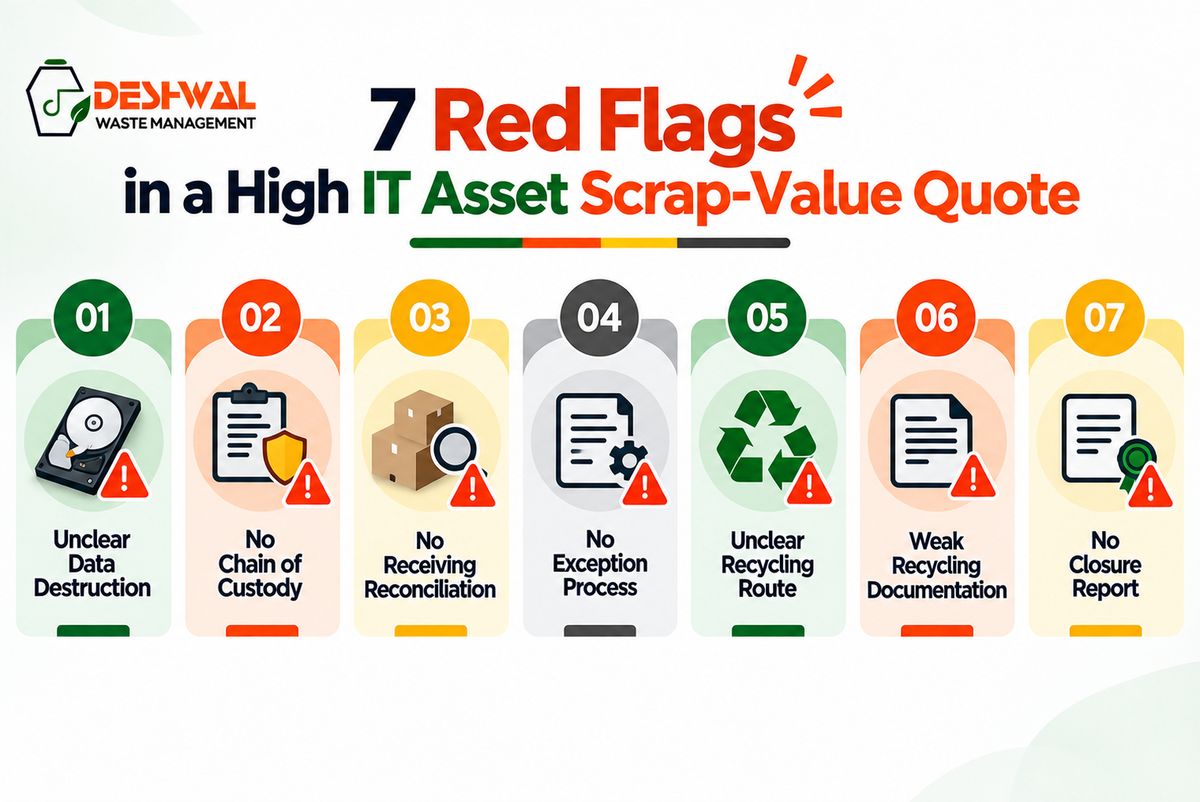
Another warning sign is treating all assets as one mixed lot. A laptop, hard drive, UPS battery, server, monitor and cable bundle do not carry the same risk or recovery potential.
A strong quote should explain the process, not only the price.
It should clarify pickup, reverse logistics, data destruction, grading, buyback, recycling, EPR-support documentation where applicable and final closure reporting.
The question is not whether recovery value matters.
It does.
The question is whether the recovery value is supported by a process the enterprise can defend later.
Where Deshwal fits in ITAD compliance and asset recovery
Deshwal’s role in ITAD compliance and asset recovery is strongest on the return side of the asset lifecycle.
This includes reverse logistics, ITAD, data sanitisation, data destruction, buyback, asset recovery, refurbishment coordination, e-waste recycling and disposal services, lithium-ion and lead-acid battery waste handling, plastic fractions recovered from e-waste, EPR support and compliance reporting.
For enterprises, this matters because IT asset disposal is not a one-department decision.
IT needs asset visibility.
Security needs data-risk closure.
Procurement needs accountable execution.
Finance needs recovery-value reconciliation.
ESG and compliance teams need records that can support internal review, EPR-related documentation, BRSR inputs for relevant listed entities and closure reporting.
The goal is not only to sell old hardware.
The goal is to recover value without losing control.
To discuss ITAD, buyback, asset recovery and documentation-led closure, contact Deshwal.
FAQs
What is ITAD compliance?
ITAD compliance refers to the controls, documentation and process discipline used when retiring IT assets. It includes inventory, reverse logistics, chain of custody, data sanitisation or destruction, asset recovery, recycling and closure reporting.
Why should compliance come before scrap value?
Compliance should come before scrap value because retired IT assets may contain data, batteries, reusable components, recyclable materials and documentation requirements. A high quote is useful only when the asset route, data handling and closure records can be proven.
What is asset recovery value?
Asset recovery value is the commercial value recovered from retired IT assets through buyback, resale, reuse, refurbishment coordination, parts recovery or material recovery after data risk and custody controls are addressed.
Is IT asset buyback the same as ITAD?
No. IT asset buyback is one part of ITAD. ITAD is broader and includes inventory, reverse logistics, data destruction, chain of custody, grading, buyback, reuse, recycling and closure reporting.
What documents should enterprises maintain for IT asset disposal?
Enterprises may need asset inventory, pickup records, chain-of-custody documents, receiving and reconciliation reports, data sanitisation or destruction evidence, failed-wipe reports, buyback summaries, recovery records, recycling records, battery-waste records and final closure reports.